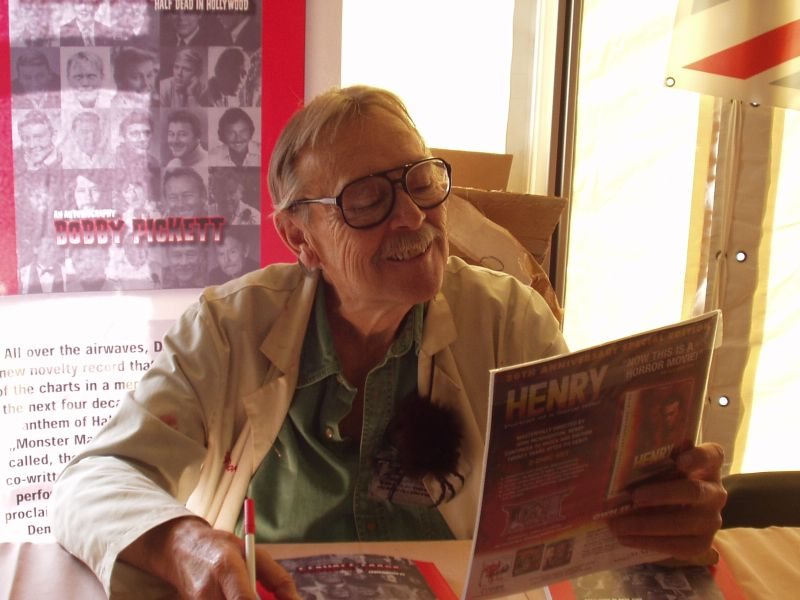
Photo: Leslie Gottlieb, CC BY 2.0, via Wikimedia Commons
Sixty-four years ago this week, the number one record in America was sung by a struggling actor doing an impression of Boris Karloff. Bobby Pickett's "Monster Mash" topped the Billboard Hot 100 on October 20, 1962, and stayed there for two weeks, right through Halloween.
It has never really left. Every October the song comes back to radio, party playlists and school discos, and it now sits alongside the big Christmas standards as one of the few pop records tied to a single date on the calendar.
How it got there is a very 1962 story, and it has more to do with a dance craze and a few kitchen sound effects than with any grand plan.
A singer who wanted to be an actor
Pickett had moved to Los Angeles hoping to act. To pay the bills he sang with a local band, and the tale that gets told in nearly every account of the song goes like this: during a performance of the doo-wop hit "Little Darlin'," he dropped into his Boris Karloff voice for the spoken part, and the audience loved it.
That was the seed. Pickett and a bandmate, Leonard Capizzi, worked the impression into a song of their own. The pop charts that year were full of dance records, and one of the biggest was Dee Dee Sharp's "Mashed Potato Time." Put a horror-movie voice on top of a dance craze and you get the "Mash."
Pickett did more than one voice on the finished record. Alongside the Karloff narrator there is a Bela Lugosi-style Dracula, which is the sort of detail you only notice on about the tenth listen.
How the record was made on a shoestring
The producer was Gary S. Paxton, who already had a novelty hit behind him, and the track came out on his small Garpax label. Accounts usually say several major labels passed on it first. I believe that, because on paper a monster dance song from an unknown actor is a strange thing to sign.
The session band is part of the legend too. Leon Russell, later a big name in his own right, is usually credited with playing piano on the record, though session credits from that era can be fuzzy.
Then there are the sound effects, which I think are the best part. According to the story Pickett and others told over the years, the creaking coffin lid was a nail being pulled out of a board, the bubbling cauldron was someone blowing through a straw into water, and the rattling chains were chains dropped on the studio floor. It sounds like a school play, and somehow on the record it works.
Number one, and then banned in Britain
In America the song was a fast hit, reaching the top of the Hot 100 in time for Halloween 1962. Pickett and the band, billed as the Crypt-Kickers, followed it up that December with a Christmas sequel, "Monster's Holiday," which charted but never came close to the original.
The BBC was less amused. It refused to play "Monster Mash" in 1962, reportedly judging it offensive. That sounds absurd now (it is about as frightening as a cartoon), but the ban held for years. When the record was reissued in 1973, it finally became a big British hit, climbing to number three in the UK.
The 1973 reissue did well in America as well, putting the song back in the US top 10 more than a decade after its first run. Not many records manage a second peak like that, and fewer still do it in a costume.
Why it keeps coming back every October
Part of it is simple supply. There are a lot of Christmas songs and very few Halloween songs that everybody knows, so the handful that exist get played to death. "Monster Mash" has the advantage of being a real dance record with a proper beat underneath the jokes, which is why it still fills a room.
It is also friendly. The monsters are throwing a party rather than chasing anyone, so the song gets played in kindergarten classrooms and at grown-up costume parties in the same week.
It helps that the whole thing is over in about three minutes, which is roughly how long a novelty joke should last.
Pickett's long life as "Boris"
Pickett never quite escaped the song, and by most accounts he made peace with that. He kept the "Boris" nickname, performed the song for decades, and appeared at fan conventions and oldies shows. He also recorded new versions of it over the years.
He died in April 2007, at the age of 69. The record had already outlived most of its 1962 chart rivals by then, and it has only grown more familiar since streaming made seasonal listening so easy to track.
Putting it on your playlist this year
If you are building a Halloween playlist, the original 1962 recording is the one to find. Later re-recordings and covers exist, and some are fun, but none have the same rough charm as the Garpax single. Listen on decent speakers or headphones and you can pick out the straw in the water and the nail in the board.
"Monster Mash" pairs well with the other usual suspects, such as Michael Jackson's "Thriller" and Ray Parker Jr.'s "Ghostbusters," though I would put it first in the running order, if only because it got there twenty years before either of them.
Enjoyed this story?Get a new one every day on social.