Photo: Powhusku, CC BY-SA 2.0, via Wikimedia Commons
Black Friday falls on November 27 this year, the day after Thanksgiving, and the emails have already started. Mine began around Halloween, which feels early even by modern standards.
Ask most people where the name comes from and you will hear the same tidy answer. Retailers spend most of the year running at a loss, "in the red," and the day after Thanksgiving is when the books finally swing into profit, "in the black." It is a nice story. It also showed up decades after the name did.
The real origin is less flattering to shoppers and a lot more Philadelphia.
The first Black Friday had nothing to do with shopping
Before it meant doorbusters, "Black Friday" was a phrase for financial disaster. The most famous one was September 24, 1869, when the gold market in New York collapsed. Two speculators, Jay Gould and James Fisk, had tried to corner the market in gold, and the scheme fell apart once the federal government released gold for sale. Prices crashed and plenty of investors were ruined.
That is the background to the phrase: a black day, a bad day. Keep it in mind, because the shopping version started out meaning something similar.
Factory bosses and sick workers
One of the earliest documented links between Black Friday and Thanksgiving comes from 1951, in a trade journal called Factory Management and Maintenance. It used the term for the day after the holiday because so many workers called in sick to stretch the break into a four-day weekend. Managers did not find this funny.
So in its first Thanksgiving use, Black Friday was a complaint. It was not about sales at all.
Philadelphia police and the Army-Navy game
The meaning we use now comes from Philadelphia in the 1950s and early 1960s. The day after Thanksgiving pulled huge crowds of shoppers downtown, and for years the Army-Navy football game was played in the city on the Saturday after Thanksgiving, which brought in even more visitors.
The city's police officers had to deal with all of it. Traffic jams, packed sidewalks, shoplifters, long shifts with no days off. They started calling it Black Friday, and they did not mean it kindly.
Local merchants hated the name. In 1961 they tried to rebrand the day as "Big Friday," which went about as well as you would guess. The police term kept spreading through the city's newspapers and, by the mid 1960s, into local advertising.
How stores turned a gripe into a holiday
For a long time the phrase stayed mostly a Philadelphia thing. It crept into national use through the 1980s, and that is roughly when the "in the black" explanation started circulating. Retailers had a good reason to like it. It turned a cop's complaint about chaos into a cheerful story about the season paying for itself.
I don't think anyone set out to rewrite the history on purpose. The accounting explanation is simply easier to say in a TV segment than "police officers in one city were annoyed about traffic," and once it was repeated enough times, it became the version people knew. Plenty of word origins go this way.
There is a bit of older history tucked in here too. In 1939, President Franklin Roosevelt moved Thanksgiving a week earlier, partly to give stores a longer shopping stretch before Christmas. People mocked it as "Franksgiving," and in 1941 Congress fixed the holiday on the fourth Thursday of November, where it has stayed. Retail has been leaning on that Friday for a long time.
By the early 2000s, Black Friday was regularly reported as the busiest shopping day of the year in the United States. Then in 2005, Shop.org, part of the National Retail Federation, coined "Cyber Monday" for the online sales the following week, and the long weekend of deals was basically complete.
The name went global
Over the 2010s the idea traveled well beyond the US, helped along by online retailers. Stores in the UK, across Europe and elsewhere now run Black Friday promotions, often stretched across a full week or the whole month. (Shops in the Netherlands, for example, put "Black Friday" signs in their windows despite having no Thanksgiving to follow.)
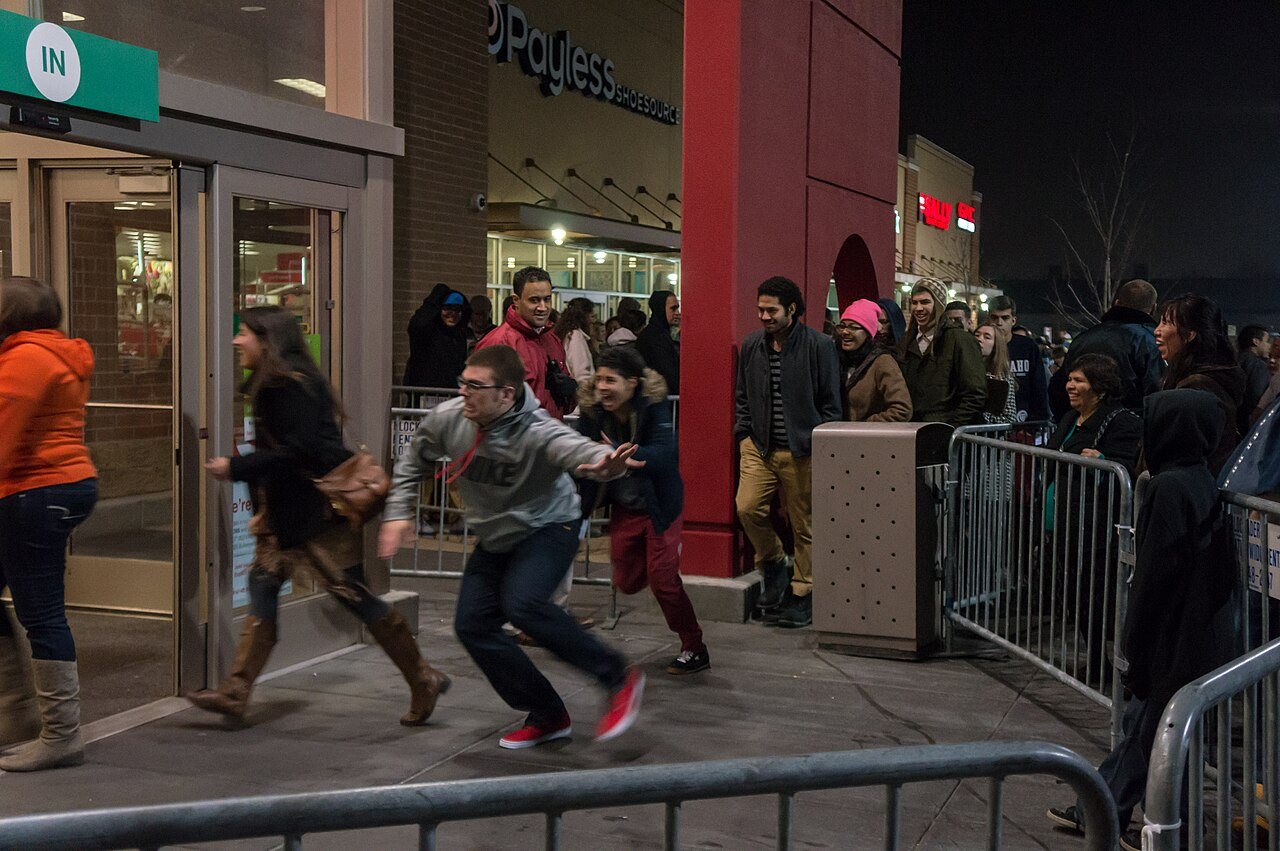
The photo at the top of this story is the version most of us picture: a crowd behind barriers, doors open, people running. That scene is a bit rarer now that so many deals start online days earlier, which I count as progress.
What to do with this before November 27
The useful part of knowing the history is that it takes some of the magic out of the day. Black Friday was named for chaos, and the "best day of the year for stores" pitch is marketing that came later.
A few practical habits help. Price-check the items you actually want now, so you know whether the Black Friday price is a real drop or the usual price with a bigger sign. Many retailers spread their offers across November, so the "one day only" framing is often loose. And if the thought of a crowded store on the Friday makes you tired, the Philadelphia police of 1961 would understand completely.
Enjoyed this story?Get a new one every day on social.